IVRT vs IVPT: Choosing a Diffusion Cell System
Two laboratories can test the same cream using diffusion cells and still be investigating different questions. One wants to understand how the drug leaves the formulation. The other needs to evaluate how it passes through skin.
That difference determines more than the study name. It affects membrane selection, cell configuration, sample application, receptor medium, analytical sensitivity and the equipment package you should request.
This guide compares in vitro release testing and in vitro permeation testing, then explains how to specify a Copley HDT 1000 vertical diffusion cell system for your intended application in Egypt.
What Is the Difference Between IVRT and IVPT?
In vitro release testing, or IVRT, evaluates the release of an active ingredient from a formulation into a receptor medium, commonly through a suitable synthetic membrane.
In vitro permeation testing, or IVPT, evaluates drug movement through a biological barrier. For regulatory studies of topical dermatological products, this commonly involves appropriately prepared excised human skin.
Both studies may use diffusion cells, but they do not measure the same performance characteristic. The study objective should be defined before selecting the cells, accessories and sampling arrangement.
Planning a Release or Permeation Study?
Send Gemicatech your formulation type, study objective, membrane or skin requirements, expected sample workload and sampling schedule. Request an equipment configuration matched to the study rather than a quotation for the heating unit alone.
IVRT vs IVPT at a Glance
| Selection Factor | IVRT | IVPT |
|---|---|---|
| Main question | How does the active ingredient release from the formulation? | How does the active ingredient permeate through the selected skin barrier? |
| Typical barrier | A suitable synthetic membrane selected and evaluated during method development. | Appropriately prepared skin; regulatory topical studies commonly use excised human skin. |
| Typical outputs | Cumulative amount released per unit area and release rate, according to the method. | Cumulative amount permeated, flux-related measures and other method-defined endpoints. |
| Important sources of variation | Membrane suitability, formulation application, temperature, medium and sampling. | Skin donor and integrity, preparation, dose application, temperature and sampling. |
| Equipment implication | Specify the required cell geometry, membrane arrangement, heating and sampling. | Specify suitable skin cells and the wider requirements for skin handling and barrier assessment. |
Buying a system capable of accommodating different cell types can support flexibility. It does not, by itself, establish that a validated IVRT or IVPT method is available for your product.
Which Study Does Your Laboratory Need?
Consider IVRT When the Main Question Is Formulation Release
IVRT can support formulation comparison, method development and assessment of changes in release behaviour. Depending on the product and approved control strategy, it may also have a role in quality testing or comparative development.
The membrane should be evaluated for compatibility, drug binding and its influence on release. A membrane that introduces an unsuitable rate-limiting barrier can obscure the formulation behaviour you intended to measure.
Consider IVPT When Skin Permeation Is the Required Endpoint
IVPT introduces the biological barrier as a central part of the experiment. Skin preparation, integrity, donor variability and dose application therefore become major study-design considerations.
Regulatory requirements may specify the skin source, study design and analysis. Confirm current product-specific guidance and the intended submission pathway with your regulatory and scientific teams.
Do You Need Both?
Some development programmes use both because release from the formulation and permeation through skin provide different information. Do not assume that a satisfactory IVRT result establishes satisfactory skin permeation or clinical equivalence.
If both are planned, ask the supplier which parts of the equipment can be shared and which cells, accessories or supporting capabilities need separate specification.
Copley HDT 1000: A System to Evaluate for Your Study
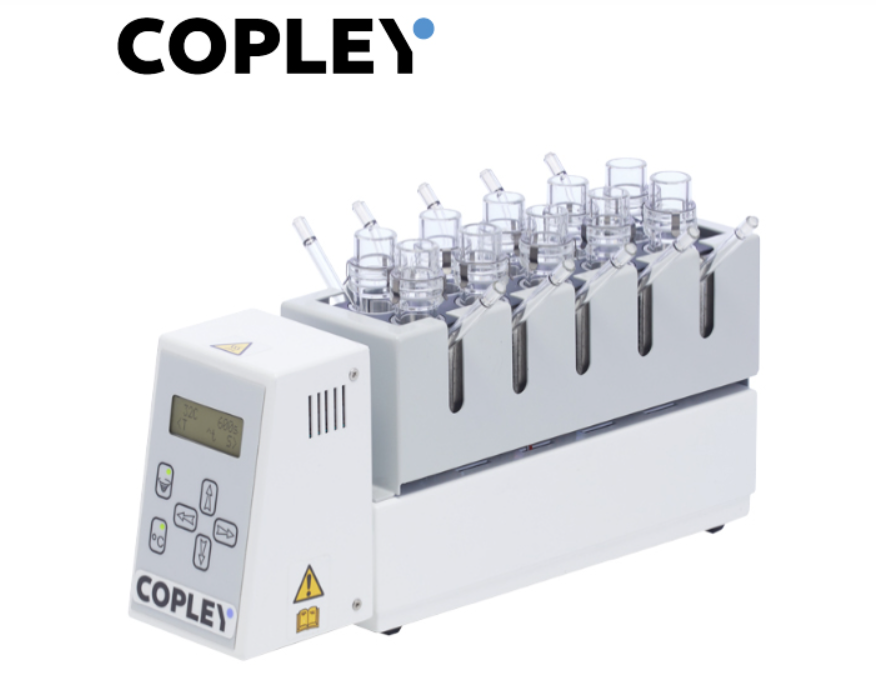
Gemicatech lists the HDT 1000 as a vertical diffusion cell system with a dry heating block and integrated magnetic stirring. The system accommodates up to 10 vertical diffusion cells.
Its dry-heat arrangement removes the water-jacket tubing associated with water-based cell heating. A dedicated stirrer beneath each station supports receptor-medium mixing during testing.
| Specification | Published Information | What to Confirm |
|---|---|---|
| Pharmacopoeial reference | USP <1724>. | Suitability for your current approved study method. |
| Cell capacity | Up to 10 vertical diffusion cells. | Number of cells included and required study capacity. |
| Cell types | B, C and Skin. | Geometry, membrane arrangement and application compatibility. |
| Heating | Dry heating block. | Required operating conditions and temperature-verification approach. |
| Mixing | Dedicated magnetic stirring beneath each station. | Stirring conditions required by the receptor-medium method. |
| Sampling compatibility | Endpoint, discrete and fully automatic arrangements listed. | Included sampling equipment and additional automation components. |
| Cell preparation | Dedicated cell-clamping arrangements. | Closure configuration, donor setup and operator procedure. |
The product description emphasizes endpoint and discrete manual sampling, while its specification table also lists fully automatic compatibility. Request a clear description of the additional equipment required for the proposed automated configuration.
Choose the Cells Before Finalizing the Equipment Package
A quotation that identifies only “HDT 1000” is not sufficiently detailed for every study. Cell configuration determines important aspects of the donor and receptor arrangement.
Type B and Type C Cells
Gemicatech lists Type B and Type C cells with a clamping system intended to simplify preparation and sample collection. The available tops support open and closed or occluded arrangements.
Confirm the required cell type, diffusion area, receptor volume, closure and membrane mounting with the proposed method. Open and occluded operation should not be treated as interchangeable settings.
Skin Cells
The listed skin-specific cell uses a screw-type closure intended to accommodate full-thickness membranes or skin. A side sampling arm supports filling, sample withdrawal and medium replacement.
A skin-compatible cell does not establish that every available skin preparation meets a particular regulatory study requirement. Tissue selection, preparation and integrity assessment need separate scientific control.
Synthetic Membranes Are Not Automatic Skin Substitutes
A synthetic membrane suitable for IVRT serves a different purpose from the skin barrier used in a regulatory IVPT study. Screening results obtained with an artificial barrier should not automatically be presented as equivalent to human-skin permeation data.
Specify the actual study objective when requesting membrane advice. Product development screening, routine release testing and regulatory permeation studies may require different evidence and materials.
Receptor Medium and Temperature: Small Details With Major Consequences
The receptor medium must be suitable for the active ingredient, analytical procedure and study barrier. Solubility, stability and compatibility should be assessed during method development.
For IVPT, components that improve drug solubility can also affect the biological barrier. Do not select the medium solely because it dissolves the drug efficiently.
Control temperature at the location relevant to the method. A heating-block setpoint does not by itself demonstrate the temperature at the membrane or skin surface. Define how the required condition will be established and verified.
Consider Receptor-Medium Degassing
Air trapped beneath a membrane can interfere with contact between the barrier and receptor medium. Gemicatech lists Copley’s VDA vacuum deaeration apparatus as an accessory for degassing receptor medium before use.
Ask whether a degassing arrangement is required for your procedure and whether it is included in the proposed package. Follow a defined preparation and filling procedure rather than relying on visual checks alone.
Plan Sampling and Drug Analysis as One Workflow
The diffusion system controls the exposure conditions, but it does not independently determine drug concentration. Collected receptor samples need an appropriate analytical procedure.
Depending on the formulation and study, this may involve chromatography or another suitable validated method. Sensitivity must be adequate for the expected concentrations, particularly at early sampling times.
- Define sampling times and withdrawal volumes.
- Specify whether and how receptor medium is replaced.
- Account for removed drug when calculating cumulative amounts.
- Assess sample stability and any filtration requirements.
- Confirm compatibility of sampling tubing and collection vessels.
- Plan how results are normalized to diffusion area.
Automated sampling may reduce repetitive handling, but it introduces components that must be evaluated for timing, recovery, carryover and compatibility. Do not assume that automation automatically validates the complete method.
How Many Cells Should You Specify?
Up to 10 positions provide useful parallel capacity, but the number of required cells should come from the study design, not simply from the instrument maximum.
Consider formulation groups, replicates, controls and development work. IVPT may require a donor-balanced study design with multiple runs; one full instrument run may not represent a complete study.
Ask for confirmation of the cell quantities supplied. Maximum instrument capacity and the number of cells included in a commercial offer are different purchasing details.
What Should an IVRT or IVPT Equipment Quotation Include?
| Quotation Item | Information to Request |
|---|---|
| Study scope | IVRT, IVPT or both, with the intended method reference. |
| Main system | Exact instrument and included control components. |
| Cells | Type, quantity, receptor volume, diffusion area and closure. |
| Barrier materials | Required membrane accessories or skin-cell arrangement. |
| Sampling | Manual accessories or the complete additional automation package. |
| Medium preparation | Degassing and other equipment required by the method. |
| Documentation and service | Manuals, available qualification support, installation and training. |
| Commercial conditions | Current price, taxes, warranty, delivery terms and confirmed lead time. |
Share the formulation, active ingredient, study objective, proposed barrier and sampling plan with Gemicatech. Where the method is still being developed, explain which requirements remain undecided.
Keep Release Testing Separate From Other Semisolid Measurements
Viscosity and texture tests can describe important physical properties of a cream or gel. They do not independently measure drug release or skin permeation.
If the laboratory also needs formulation-characterization equipment, review the viscometer and rheometer range separately against those requirements. Avoid treating one type of measurement as a substitute for another.
For the wider pharmaceutical equipment portfolio, read the pharmaceutical testing equipment guide . For implementation and ongoing assistance, review Gemicatech’s laboratory equipment support information . Confirm the project-specific service scope in writing.
Frequently Asked Questions
Are IVRT and IVPT the same test?
No. IVRT evaluates release from the formulation, commonly across a synthetic membrane. IVPT evaluates permeation through a biological barrier, commonly excised human skin in regulatory topical studies.
Can one diffusion cell platform support both?
A platform may support different study configurations through appropriate cells and accessories. Confirm compatibility with each method; shared equipment does not make the methods interchangeable.
Does the HDT 1000 support skin cells?
Yes. Gemicatech lists support for Type B, Type C and Skin cells. Confirm the required skin-cell geometry and included accessories for your study.
Are 10 cells included with every HDT 1000 offer?
Do not assume so. The published capacity is up to 10 cells. Ask the quotation to identify the exact number and types supplied.
Is automatic sampling included as standard?
The specification lists automatic sampling compatibility, but the base description discusses manual techniques. Request confirmation of all additional hardware and software needed for automation.
Does USP <1724> support mean our method is validated?
No. An equipment reference to USP <1724> does not establish validation of a product-specific method or regulatory acceptance of the study.
Can an IVRT result establish skin absorption?
Not by itself. IVRT release data are not a direct measurement of skin permeation or clinical performance. Interpret the study within its intended scientific and regulatory scope.
How much does an HDT 1000 system cost in Egypt?
Request a current quotation covering the unit, cells, accessories, sampling arrangement and required support. A base-unit price may exclude important study components.
Specify the Study First. Buy the Right Configuration Second.
A useful diffusion-cell purchase starts with a clear question: release from the formulation, permeation through skin, or both. Once that is established, the cells, sampling and supporting equipment can be specified with much greater confidence.
Send Gemicatech your formulation type, method, expected workload and sampling requirements to discuss an HDT 1000 configuration and request a written technical and commercial offer.