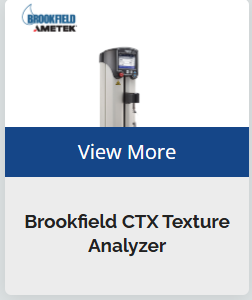
Measure product texture, hardness, firmness, elasticity, gel strength and breaking behavior with professional Texture Analyzers in Egypt. These instruments help food manufacturers, pharmaceutical companies, cosmetics laboratories and R&D teams turn subjective texture descriptions into measurable test results.
Gemicatech helps Egyptian laboratories select the right texture testing solution based on sample type, test method, load cell, probe, fixture, software and daily workload.
Need a Texture Analyzer for your laboratory?
Send us your product type, required test, sample dimensions and expected testing volume. Our team can help you choose a suitable configuration through the Contact page or WhatsApp.
Request a Quote Talk to an Expert Free ConsultationWhat is a Texture Analyzer?
A Texture Analyzer is a precision testing instrument that applies controlled movement or force to a sample and records the sample’s response. The result may be displayed as force, distance and time data, usually in the form of a test curve.
By changing the probe, fixture, load cell and test method, the same instrument can evaluate different physical properties such as hardness, firmness, elasticity, adhesiveness, gel strength, brittleness, springiness and resistance to penetration.
Objective Results
Convert subjective texture descriptions into measurable force, distance and time data.
Flexible Testing
Use different probes and fixtures for food, pharmaceutical, cosmetic and material samples.
Quality Control
Compare formulations, batches, raw materials and production conditions with repeatable methods.
Why use Texture Testing Equipment?
Texture affects product quality, consumer acceptance, process control and shelf-life. However, texture can be difficult to describe accurately using only visual inspection or manual touch.
A professional Texture Testing Equipment system allows laboratories to define a repeatable test and compare results across formulations, production batches, raw materials and storage conditions.
- Improve product consistency: Compare texture values between batches.
- Support formulation development: Evaluate the effect of ingredients and processing conditions.
- Reduce subjective judgment: Replace informal descriptions with measurable data.
- Support quality control: Define acceptance ranges for finished products.
- Study shelf-life: Monitor texture changes during storage and handling.
- Improve packaging decisions: Evaluate product strength and packaging interaction.
Applications by industry
| Industry | Common Samples | Typical Tests | Measured Properties |
|---|---|---|---|
| Food & Beverage | Bread, biscuits, dairy, meat, fruit, vegetables, confectionery and gels | Compression, penetration, cutting and puncture | Firmness, hardness, chewiness, crispness and elasticity |
| Pharmaceuticals | Tablets, gels, ointments, capsules and gelatin products | Compression, penetration, spreadability and breaking tests | Tablet firmness, gel strength, consistency and spreadability |
| Cosmetics | Creams, gels, lotions, lipsticks, mascaras and pastes | Penetration, compression, extrusion and spreadability | Consistency, firmness, adhesiveness and application behavior |
| Packaging | Films, closures, seals, containers and flexible materials | Tension, puncture, compression and bending | Strength, flexibility, resistance and failure behavior |
| Materials & Research | Polymers, adhesives, rubber, gels and biomaterials | Tension, compression, shear and deformation | Elasticity, deformation, strength and breaking behavior |
Texture Analyzers for food laboratories
Food texture is closely connected to product quality and consumer acceptance. A Food Texture Analyzer can help manufacturers compare the firmness of baked products, the crispness of snacks, the strength of gels, the hardness of confectionery and the consistency of dairy products.
It can also support formulation changes, raw material comparison, storage studies and quality control between production batches. The correct probe and test method depend on the product structure and the texture property being measured.
Related content: Food and Beverage Industries in Egypt: Complete Lab Solutions and Laboratory Equipment for Sugar & Food Industries.
Texture Analyzers for pharmaceutical laboratories
Pharmaceutical laboratories can use a Pharmaceutical Texture Analyzer to study tablets, gels, ointments, gelatin products and other semi-solid or solid dosage forms.
Possible applications include tablet firmness, gel strength, ointment spreadability, penetration resistance and product consistency. The selected method must match the dosage form, approved procedure and laboratory quality requirements.
For related pharmaceutical testing equipment, see: Pharmaceutical Tablet Testing Equipment in Egypt.
Texture Analyzers for cosmetics
Cosmetics manufacturers use texture measurements to evaluate creams, gels, lotions, lipsticks, mascaras, pastes and other personal-care formulations. Important properties may include firmness, spreadability, adhesiveness, consistency and application behavior.
A controlled texture test can help R&D and QC teams compare formulations, evaluate raw material changes and monitor product consistency during development and production.
Related content: Laboratory Equipment for Cosmetics Industry and Fragrance and Flavor Industries in Egypt.
Common texture tests
Compression testing
Compression Testing measures how a sample responds when force is applied from above. It may be used for tablets, food products, gels, packaging and other materials.
Penetration testing
Penetration Testing uses a probe to enter or move into a sample. It can help evaluate firmness, softness, consistency and resistance to penetration.
Tension and tensile testing
Tensile Testing pulls a sample until it stretches, deforms or breaks. This method is useful for films, packaging materials, flexible products and selected research materials.
Puncture and breaking tests
Puncture Testing measures the force required for a probe to penetrate a sample or packaging material. Breaking tests can help evaluate brittleness, fracture force and structural resistance.
Extrusion and spreadability tests
Extrusion and spreadability tests can help evaluate creams, gels, pastes, sauces and other products that must be pushed through an opening or spread across a surface.
How a Texture Analyzer works
A typical texture analysis system includes a motorized arm, a load cell, a probe or fixture and software. The arm moves the probe according to a defined test method while the load cell measures the force applied to or generated by the sample.
The system may record force, distance and time, then present the result as a curve or calculated value. Different parts of the curve can represent properties such as peak force, work, deformation, adhesiveness or breaking point.
How to choose the right Texture Analyzer in Egypt
1. Define the sample
Start with the product you will test: food, tablet, cream, gel, packaging film, adhesive, rubber or another material. Sample shape, size, firmness and sensitivity will determine the suitable test configuration.
2. Choose the required test method
Decide whether you need compression, penetration, puncture, tension, extrusion, bending, shear, relaxation or another method. The method should reflect the real product property you want to measure.
3. Select the correct load cell
The load cell must be suitable for the expected force range. A load cell that is too large may reduce sensitivity for soft samples, while one that is too small may be unsuitable for firm or high-force samples.
4. Review probes and fixtures
Probes and fixtures are selected according to the sample and test. Ask about compression plates, needles, cones, cylinders, blades, puncture probes, grips, extrusion cells and custom fixtures.
5. Check software capabilities
Review test programming, graph display, calculations, result storage, export formats, user management and reporting. A clear software workflow can make method development and routine QC easier.
6. Consider sample throughput
A research laboratory may prioritize flexibility, while a production QC laboratory may prioritize repeatability, speed and easy operation. Select the system according to both current and expected future workload.
Key specifications to compare
| Specification | Why It Matters | What to Confirm |
|---|---|---|
| Force Range | Determines which soft or firm samples can be measured. | Available load cells and recommended operating range |
| Probe and Fixture Options | Determines the test types and sample formats supported. | Included, optional and custom attachments |
| Travel Distance | Controls how far the probe can move during the test. | Vertical travel and sample height compatibility |
| Test Speed | Can influence deformation and measured texture properties. | Minimum, maximum and programmable speed |
| Software | Supports method creation, graphs, calculations and reporting. | Data export, user access and result storage |
| Calibration and Service | Supports reliable long-term measurement performance. | Calibration options, training and local service |
Texture Analyzer vs. Viscometer
| Factor | Texture Analyzer | Viscometer or Rheometer |
|---|---|---|
| Main purpose | Measures mechanical and physical texture properties | Measures flow and deformation behavior |
| Typical outputs | Hardness, firmness, elasticity, adhesiveness and breaking force | Viscosity, shear behavior, yield stress and flow curves |
| Common tests | Compression, penetration, puncture, tension and extrusion | Rotational, oscillatory and flow measurements |
| Typical samples | Food, tablets, creams, gels, packaging and solid materials | Liquids, suspensions, creams, polymers and semi-solids |
Some laboratories need both systems. A Texture Analyzer evaluates how a product resists mechanical action, while a viscometer or rheometer focuses on flow and deformation behavior. For viscosity solutions, visit Brookfield Viscometers in Egypt.
Maintenance and good testing practice
- Keep probes, fixtures and sample-contact surfaces clean.
- Inspect the load cell and attachments before testing.
- Use the correct load cell for the expected force range.
- Prepare samples consistently before every test series.
- Keep sample temperature and storage conditions consistent when relevant.
- Use the same test speed, distance and probe for comparable results.
- Record method versions, sample information and test conditions.
- Schedule calibration and service according to laboratory requirements.
Why choose Gemicatech?
Choosing a Texture Analyzer in Egypt requires more than selecting an instrument with a suitable force range. The complete solution must match the sample, probe, fixture, software and laboratory workflow.
Gemicatech can help Egyptian companies and laboratories review their application before requesting a quotation. This approach is useful for food manufacturers, pharmaceutical QC departments, cosmetics R&D teams, packaging companies and research laboratories.
- Application-based equipment selection.
- Support for food, pharma, cosmetics and materials testing.
- Guidance on load cells, probes and fixtures.
- Quotation support based on the real test method.
- Installation, training and after-sales coordination in Egypt.
Related laboratory solutions
Frequently Asked Questions
What is a Texture Analyzer?
A Texture Analyzer applies controlled force or movement to a sample and measures its response in terms of force, distance and time.
What can a Texture Analyzer measure?
Depending on the probe and test method, it can measure hardness, firmness, elasticity, adhesiveness, gel strength, brittleness, springiness, penetration resistance and tensile behavior.
Which industries use Texture Analyzers?
Texture Analyzers are used in food and beverage, pharmaceutical, cosmetics, packaging, materials, research and quality control laboratories.
How do I choose the right Texture Analyzer?
Consider the sample type, required test, force range, load cell, probe, fixture, travel distance, test speed, software and daily testing volume.
Can Gemicatech supply Texture Analyzers in Egypt?
Yes. Contact Gemicatech to discuss your application, test method, sample and required configuration before requesting a quotation.
Measure texture with confidence
Send us your product type and required test. Get professional guidance and a quotation for Texture Analyzers in Egypt from Gemicatech.
Get the Best Price Contact on WhatsApp Visit Gemicatech